
Capabilities
Most of what follows is the reason a plant calls a cooling tower specialist instead of a general contractor. These are the jobs that depend on knowing how a tower behaves, not just how to build a structure.
We can rebuild your tower without shutting the plant down
On a multi-cell tower we take one cell out of service, dismantle it, rebuild it and return it to service, then move to the next. The rest of the tower keeps running the whole time.
The difference this makes is not a scheduling convenience. A full tower replacement means a plant outage, and a plant outage has to be justified, planned around a turnaround window and paid for in lost production. Cell-by-cell replacement changes that calculation completely: instead of losing the tower, you give up a fraction of your cooling capacity for a period.
For a six-cell tower, that is roughly a sixth of capacity at a time, often absorbable by running the remaining cells harder, taking advantage of cooler weather, or trimming a non-critical load. The work no longer has to wait for a turnaround.
Where it applies
- Full structural replacement of an end-of-life tower, cell by cell
- Fill, drift eliminator and distribution replacement across a whole tower
- Mechanical equipment renewal: gearboxes, drive shafts, fans, motors
- Partial rebuilds after storm, freeze or fire damage to specific cells
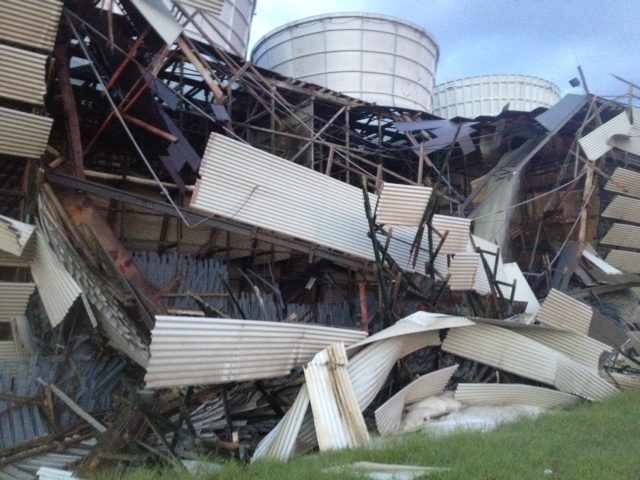
Total structural failure of one section. The intact cells behind it stayed in service throughout the rebuild.
Keeping the expensive parts of what you already have
The structure of a cooling tower is rarely the costly element. The basin, the foundations, the piping and the civil works are. The three approaches below are designed to keep them.
New towers on existing basins
A new tower designed to land on the cold water basin, foundations and piping you already own. You get current-generation thermal performance without the civil works, the excavation or the pipework rerouting that a greenfield tower implies.
- No new basin or foundation work
- Existing supply and return piping retained
- Structural material can change: timber to FRP or steel
Crossflow to counterflow conversion
Where the application justifies it, converting a crossflow tower to counterflow can deliver a closer approach and better thermal efficiency in the same footprint. It is not automatically the right answer, and we will say so when it is not.
- Closer approach to wet bulb
- Enclosed distribution: less algae growth
- Evaluated against fouling risk first
Eliminating a cell
A thermal upgrade can be aimed at capacity rather than temperature. If modern internals let the remaining cells carry the duty, a cell can become a permanent standby, or come out of service for good, with its fan power and maintenance cost.
- Frees a cell as redundancy
- Removes its fan horsepower from the bill
- Fewer gearboxes and drives to maintain
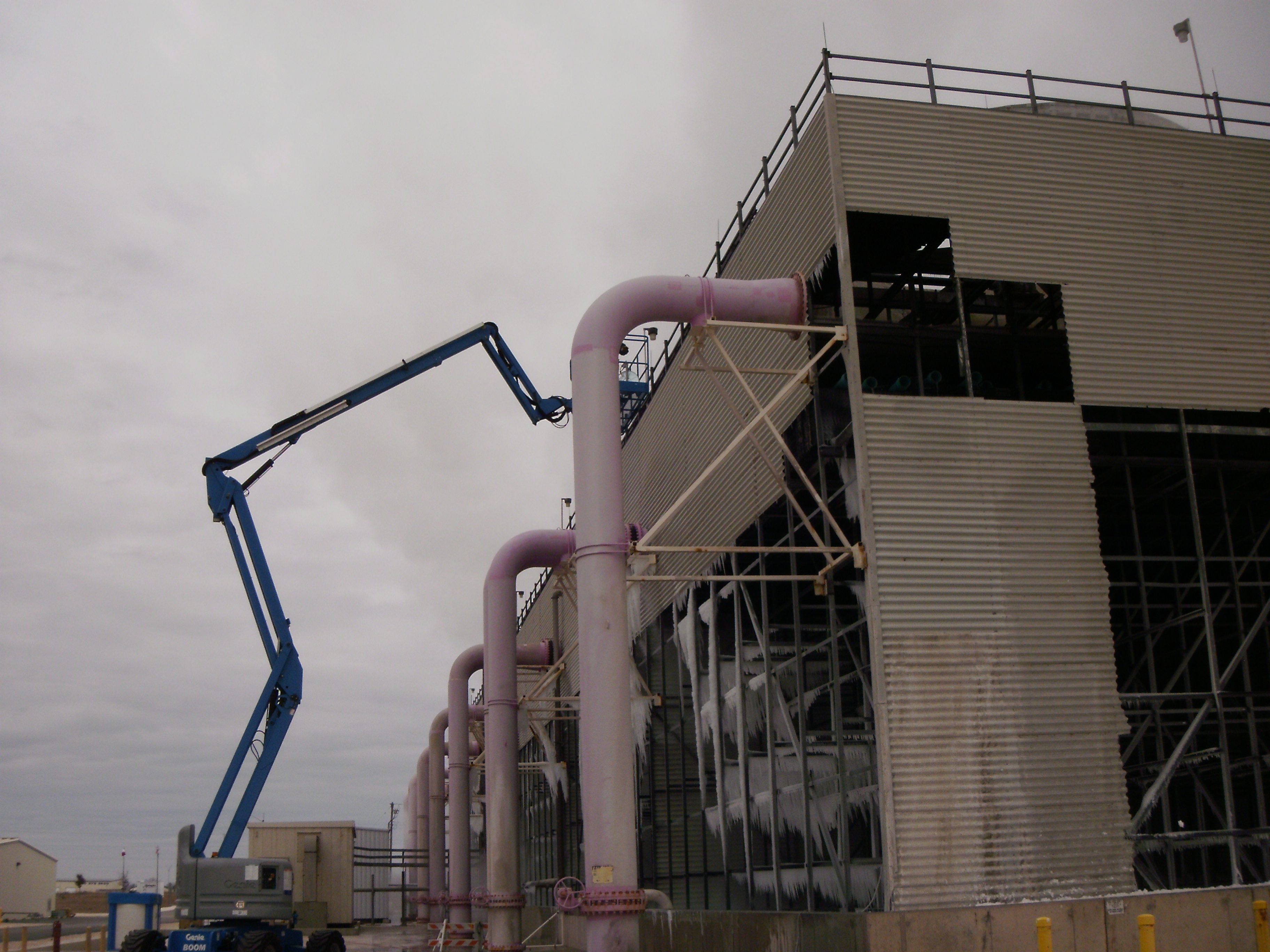
Icing across the air inlet face of a field-erected tower. Casing off, lift on site; this is documentation of our own work, not a stock photograph.
Towers that do not run in textbook conditions
A tower operating at the edges of its design envelope fails differently, and fails faster. Much of our work involves exactly those applications.
Water chemistry
High and low pH water. Aggressive water chemistry drives material selection through the whole tower: fill grade, hardware alloy, casing resin, fastener metallurgy. Getting it wrong produces a tower that looks correct on paper and disintegrates in service.
Thermal extremes
High hot water temperatures. Elevated inlet temperatures affect fill selection and structural material, and rule out some components entirely.
Low wet bulb and close approach. Applications that need to approach the wet bulb temperature closely are the hardest thermal designs to get right, and the least forgiving of a component substitution made for cost.
Severe winter operation
Freeze protection is a design problem, not just an operating procedure: air path management, distribution design, fan reversal capability, de-icing strategy. And when a freeze event does damage a tower, someone has to remove an ice-loaded fan assembly from a stack. We have photographs of ours doing it.
Seismic
Seismic loading changes the framing, the connection hardware and the anchorage of a field-erected tower. It is designed in from the start.
All four structural materials, in-house
Timber, concrete, steel and fiberglass are genuinely different trades. A contractor who works in one tends to recommend that one. We work in all four, which means the recommendation can follow the application instead.
Timber
CTI-grade Douglas fir and redwood, pressure treated, thru-bolted framing. Still the right answer for many existing towers, and repairable member-by-member in a way steel is not.
Concrete
Long design life and the best fire performance of the four. Usually encountered as an existing structure needing internals, mechanical equipment and basin repair rather than a new build.
Steel
Galvanized and coated steel framing and casing, and steel hot and cold water basins. Fast to erect; its service life is decided almost entirely by the coating system and the water chemistry.
Fiberglass
Pultruded FRP structural shapes, casing, decking and grating. Non-conductive, corrosion-proof and the usual answer where water chemistry has already destroyed steel once.
Every manufacturer, every model, every type
We do not manufacture towers, so we have no incentive to recommend one brand over another, or to recommend replacement when a repair would do. That includes towers whose original makers no longer exist.
- Counterflow
- Crossflow
- Doubleflow
- Single flow
- Induced draft
- Forced draft
- Hyperbolic / natural draft
- Circular
- Field-erected
- Factory-assembled
- HVAC
Tell us what makes your tower difficult
Aggressive water, a duty that has grown past the original design, a freeze that took out a cell, or an outage window that does not exist. Those are the conversations we are most useful in.
- Phone
- (713) 643-0691
- Shop & office
-
3811 Cedar Blvd Ste A
Baytown, TX 77523