
Emergency service
When a cooling tower goes down, the tower is rarely the problem; the production it was cooling is. Downtime is lost money, and that is the clock we work against.
Call us immediately for any of these
You do not need to diagnose it first. If cooling is lost or about to be lost, that is the call.
Mechanical failure
A gearbox that has seized or is running hot, a broken drive shaft, a failed coupling, a motor that has burned out, or a vibration switch that keeps tripping the fan out.
- Fan not turning on one or more cells
- Unusual noise or vibration
- Repeated vibration trips
Structural failure
Collapsed fill, a fallen fan deck section, buckled framing, casing torn away, or a basin leaking badly enough to threaten makeup. Partial collapse is a safety exclusion zone as well as an outage.
- Visible sag or displacement
- Fill or eliminators in the basin
- Anything you have had to barricade
Lost cooling capacity
Cold water temperature climbing with no mechanical fault: plugged distribution, collapsed or fouled fill, a stuck flow control valve. The tower is running and still not cooling.
- Process or condenser limits being hit
- Approach suddenly wider than normal
- Dry patches visible in the fill
Freeze damage
Ice loading on the fill, the inlet louvers or the fan stack. Ice is heavy, it breaks structure and blades, and an ice-loaded fan assembly has to be dealt with by people who have done it before.
- Ice on louvers, fill or fan stack
- Fan unable to start under ice load
- Structural damage after a thaw
Storm damage
Hurricane, tropical storm or high-wind damage to casing, fan stacks, structure or mechanical equipment, plus debris in the basin and distribution.
- Casing or louvers torn off
- Fan stack displaced
- Debris ingested into the tower
Outage discoveries
You opened the tower during a turnaround and found something nobody budgeted for, and the window is already running. These are common and we treat them as emergencies.
- Condition worse than expected
- Scope growth mid-outage
- Parts needed inside the window
A specialist crew, not a general contractor learning your tower
We are a cooling tower company. That means the crew that arrives has worked on your make and model before, and the diagnosis does not start from scratch.
What happens when you call
- We triage on the phone. Frequently we can tell you what to check, what to isolate and what not to restart before anyone travels. Some calls are resolved here.
- We mobilize to the site. We are based in Baytown, Texas and work across the Gulf Coast, so most refinery and petrochemical corridor sites are within a short drive rather than a flight.
- We stabilize and make safe first. Getting the cell isolated, the exclusion zone right and the remaining cells carrying what they can usually matters more in the first hour than the permanent fix.
- We get you running, then we fix it properly. A temporary repair that restores cooling today is often the correct answer, with the permanent scope planned once you are not losing production.
Why the parts side matters in an outage
Emergency repairs fail on availability, not on labor. Because we run a parts operation for all makes and models (gear reducers, fans, drive shafts, motors, fill, nozzles, eliminators), we are not waiting on an OEM to decide whether your twenty-year-old tower is still supported.
We also work on towers whose original manufacturers no longer exist. That is a routine situation for us, not an obstacle.
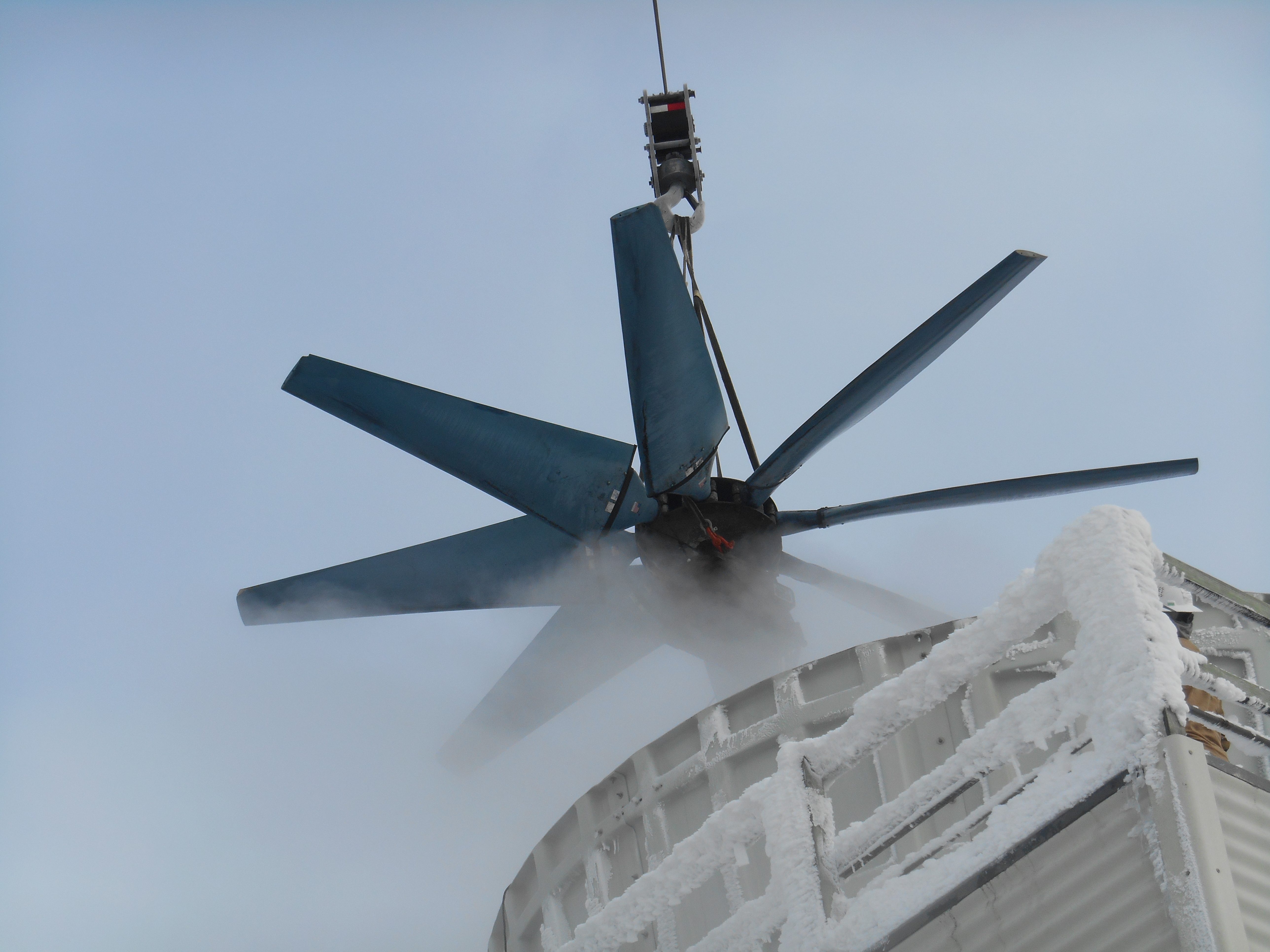
Fan assembly removed from an ice-encased stack during a freeze event. Our own work, our own photograph.
What to have ready, but call first regardless
If you have this to hand, the call is much faster. If you do not, call anyway. Nobody should be hunting for a nameplate while production is down.
The tower
- Manufacturer and model if you know it, or a photograph of the nameplate
- Number of cells and how many are affected
- Type: crossflow or counterflow, induced or forced draft, if you know
- Structural material: timber, concrete, steel or fiberglass
The symptom
- What changed, and when: sudden or gradual
- Cold water temperature now versus normal, and the flow if you have it
- Any noise, vibration or trip and what the trip was
- What you have already isolated or locked out
The site
- Location and gate or security requirements
- Site-specific safety and orientation requirements for contractors
- Crane or lift access to the tower, if you know it is restricted
- Who to speak to on site and their direct number
Photographs help more than anything
A few phone photographs (the nameplate, the failed component, the fill face, the basin) are worth a long description. Send them to sales@towerperformance.com while we are still talking.
If a fan has tripped on vibration, or there is a noise you have not heard before, resist the urge to reset and run. A vibration trip is usually the cheapest warning you will ever get, and running through it turns a coupling into a gearbox.
Do not send your own people into a tower with damaged structure, ice loading or a collapsed fan deck to have a closer look. Barricade it and let us assess it.
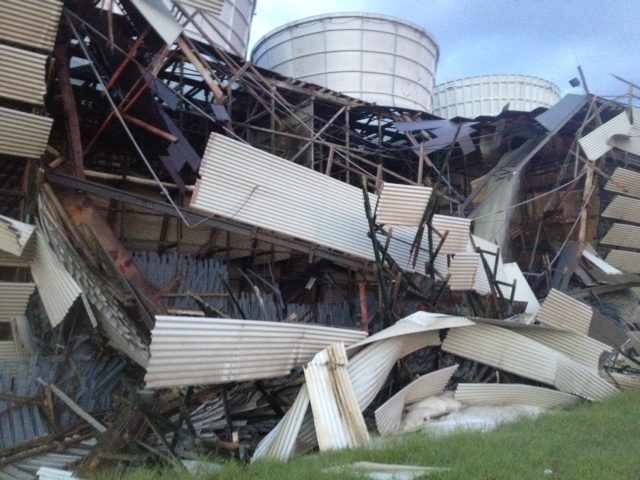
Structural failure with two cells still standing. Post-event assessment decides what can be saved and what has to be rebuilt.
Post-storm cooling tower inspection
We are a Baytown company. Hurricane season is not an unusual event here, it is part of the calendar, and cooling towers are among the most exposed structures on any plant.
A tower can look intact from the ground and still have taken real damage: fan stacks shifted out of tip clearance, casing panels sprung, drift eliminators displaced, debris driven into the fill and distribution, hardware loosened across the framing, and water in places it should not be.
After a named storm
- Structural assessment of framing, casing, fan deck and stacks
- Mechanical check: alignment, tip clearance, gearbox and drive condition before restart
- Debris removal from the fill, distribution, basin and screens
- Damage documentation suitable for an insurance claim
- Repair scope and cost so you can prioritize across the site
Before one arrives
The best time to deal with storm season is before it starts. Loose casing, corroded hardware, a fan stack that is already marginal and unsecured access grating are all cheaper to fix in April than in September.
If the tower is down, call. Do not use this form
The form is right for planned work, quotes and inspections, and we answer it quickly. For an outage, the phone is faster and we can often start diagnosing before anyone leaves the yard.
- Phone
- (713) 643-0691
- Shop & office
-
3811 Cedar Blvd Ste A
Baytown, TX 77523