
Inspections & engineering
Before committing to a thermal upgrade, a major repair or a replacement tower, find out what your tower is actually doing. We inspect it, test it, and give you a written report with costs.
Every component, inside and out
A physical inspection of all cooling tower components: structure, mechanical equipment, internals, distribution and basin. Not a walk around the outside.
Towers fail from the inside. The fill collapses, the distribution plugs, the drift eliminators fall out of their supports, the framing softens where water has been running across a connection for fifteen years. None of that is visible from the ground, and all of it shows up first as water that is warmer than it used to be.
What we look at
- Structure: framing, columns, girts, diagonals, connection hardware, fan deck, basin and casing
- Mechanical equipment: gear reducers, drive shafts and couplings, fans and hubs, motors, vibration switches, alignment and condition
- Internals: fill condition and fouling, drift eliminators, partition walls and air seals
- Water distribution: nozzles, laterals, headers, hot water basins, flow control valves
- Air path: inlet louvers, fan stack condition and tip clearance, plenum obstructions
- Safe access: ladders, stairways, walkways, grating, handrails and kneerails
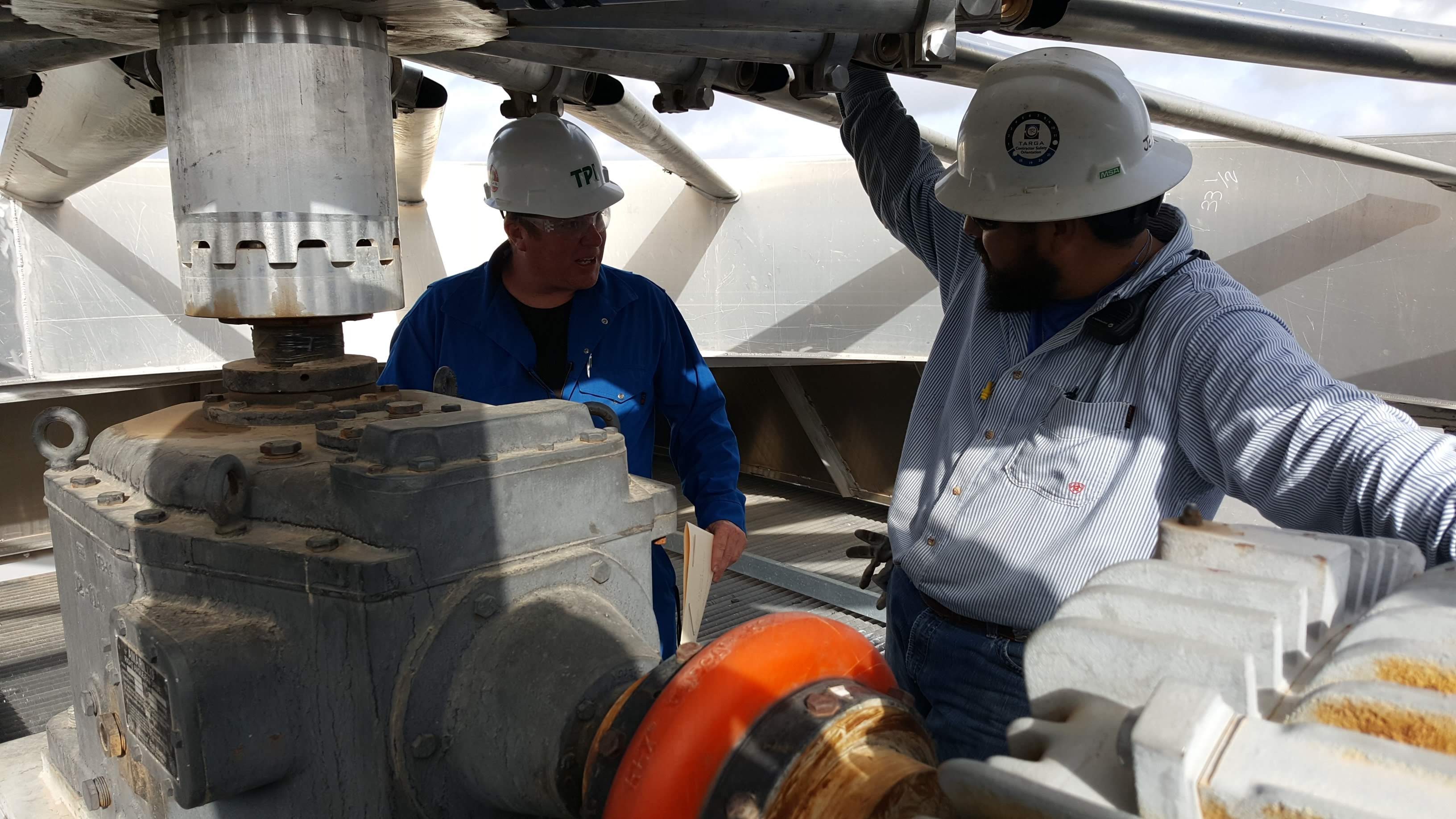
Pre-quote mechanical survey at a gas processing plant: gear reducer and vertical drive coupling.
An inspection is the cheapest thing on this website and it decides the cost of everything else. Scoping a repair without one means guessing at hidden work, and the guess is always priced defensively.
A report listing every item needing attention, and its cost
You receive a formal written report covering four dimensions. Each finding carries the associated cost, so the report is something you can take into a budget meeting rather than a list of concerns.
Safety of operation
Anything that puts your people at risk: access steelwork and grating, fall exposure, mechanical guarding, electrical condition, structural members carrying load they should not be.
Structural integrity
The condition of the framing, connections, casing, fan deck and basin, and how much service life is genuinely left in them.
Thermal performance level
What the tower is achieving now against what it was designed to achieve, and what it could achieve with current-generation internals.
General appearance
Included because it is genuinely diagnostic. Algae patterns, scale, corrosion staining and drift deposits tell you where water is going that it should not be.
We also project forward
A tower that is adequate today may not be adequate after the next debottleneck. We can project future performance against increasing or decreasing heat loads, so you find out now whether your cooling is about to become the constraint on production.
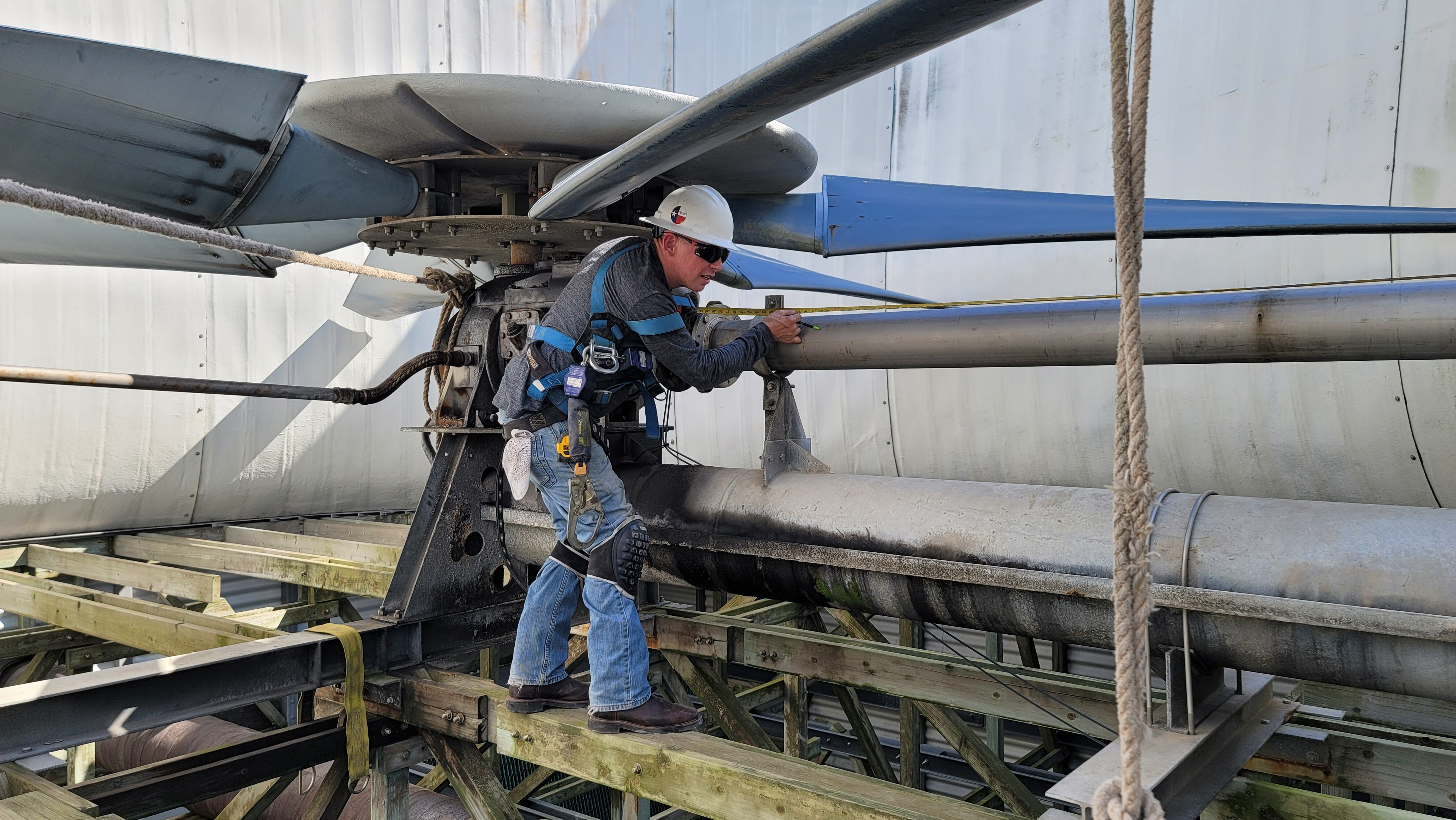
Dimensional survey on a mechanical deck. Measurement, not estimation, is the whole point of this page.
Testing to CTI ATC-105
We test cooling tower thermal performance to CTI Acceptance Test Code ATC-105, the cooling tower industry's standard method for determining whether a tower is delivering its rated capability.
This matters because "the water is warm" is not a measurement, and neither is a design temperature on a nameplate. ATC-105 establishes the tower's actual thermal capability as a percentage of its design capability, corrected for the conditions on the day of the test. It is a defensible number.
What a test gives you
- Capability as a percentage of design: the single figure that tells you whether you have a problem
- Acceptance testing on a new tower or a completed upgrade, to verify a performance guarantee
- Baseline data to measure future degradation against
- Evidence when a tower has been supplied or rebuilt by someone else and is not performing
We test our own new towers and upgrades under the same code, which is how we can guarantee performance when independently tested rather than merely predicting it.
Design and engineering for the work that follows
The inspection is normally the start of something. We carry the engineering through into the repair, the upgrade or the new tower, including turnkey projects to your specification.
Repairs & upgrades
Scoped from the evaluation, so the price reflects the tower's actual condition instead of a defensive allowance for the unknown.
View serviceNew cooling towers
Thermal design, guaranteed performance and turnkey construction, for when the evaluation concludes the tower really is finished.
View serviceParts
If your own crews will do the work, we can identify and supply the components the evaluation calls for.
Browse partsStart with an inspection
Tell us the make, the model and roughly how the tower is behaving. If it is giving warmer water than it used to, an inspection and a performance test will tell you why before you spend anything on fixing it.
- Phone
- (713) 643-0691
- Shop & office
-
3811 Cedar Blvd Ste A
Baytown, TX 77523