
Resources
Reference material for cooling tower owners, operators and maintenance planners — including field video. Useful whether or not you ever buy anything from us.
Cooling tower glossary, A–Z
A full glossary of cooling tower terminology — approach, range, drift, blowdown, wet bulb, cycles of concentration, and the rest of the vocabulary that quotations and reports assume you already know.
Cooling tower language is unusually opaque, and a good deal of it sounds like it means something other than what it means. "Approach" and "range" in particular are the two numbers that determine whether a tower is performing, and they are routinely confused.
This glossary has been part of our website for two decades, and it remains accurate because the physics has not changed. It is searchable and indexed alphabetically.
Range is the difference between the hot water coming in and the cold water going out. It is set by your process heat load and your flow rate, not by the tower.
Approach is how close the cold water gets to the ambient wet bulb temperature. That one is the tower, and it is what a thermal upgrade improves.
Cooling towers as they actually look
Drone footage from jobs we are on: a field-erected industrial tower and rooftop HVAC cells.
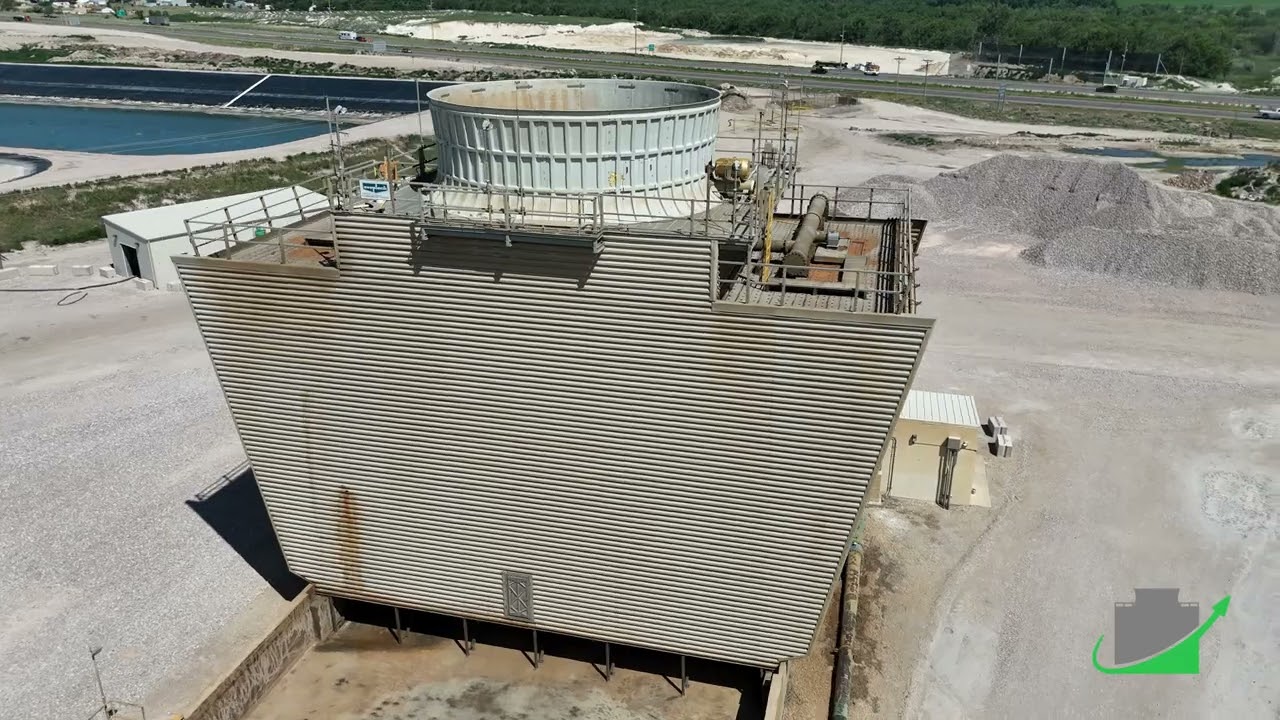
Field-erected industrial cooling tower
Drone footage of an induced draft crossflow field-erected cooling tower at an industrial plant.
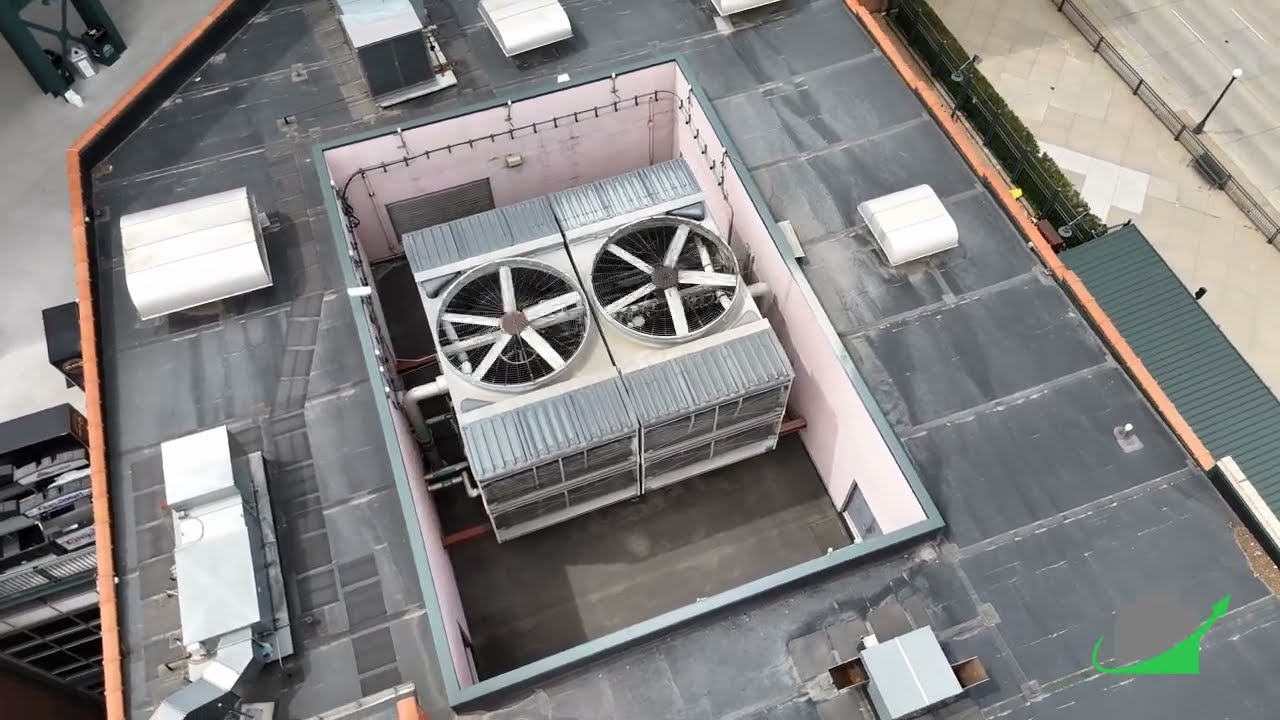
Rooftop HVAC cooling towers
Two induced-draft package towers in a rooftop well, fans visible from above, on a commercial building.
Reference material elsewhere on this site
Rather than duplicate it here, these are the pages that carry genuinely useful technical content.
Maintenance intervals
What a cooling tower needs and roughly how often — oil, alignment, vibration, fill, distribution, structure and access — as a planning reference.
View the tableTower types explained
Crossflow, counterflow, doubleflow, induced and forced draft, hyperbolic and circular — what each configuration means for how a tower fails and how it is maintained.
Compare typesComponent failure guides
Every component page carries a "what actually goes wrong" section — the failures we find in the field, in rough order of how often we find them.
Browse componentsHow performance is tested
What CTI ATC-105 thermal performance testing measures, and why "capability as a percentage of design" is the only figure worth arguing about.
Read moreOutage checklist
What to have ready when a tower goes down, and what not to do — particularly the temptation to reset a fan that has tripped on vibration.
View checklistDifficult conditions
How high and low pH water, elevated hot water temperatures, low wet bulbs, freeze exposure and seismic loading change material selection and design.
Read moreThe standards worth knowing about
If you are writing a cooling tower specification or reviewing someone else's, these are the references that come up.
| Standard | What it covers |
|---|---|
| CTI ATC-105 | Acceptance test code for water cooling towers — the standard method for determining a tower's thermal capability against its design. The number to cite in a performance guarantee. |
| CTI STD-136 | Rigid PVC material specification for fill, eliminators and louvers. Worth naming in a fill specification so you get the material you intended. |
| CTI STD-101 | Specification for water distribution nozzles. Referenced by the polypropylene counterflow nozzles we supply. |
| CTI structural timber grades | Grading rules for Douglas fir and redwood in cooling tower service. Ordinary construction grades are not equivalent. |
| AGMA standards | Gear rating and quality classes for the fan drive. Cooling tower gear drives are also rated against CTI requirements. |
| OSHA 1910 subparts D & I | Walking-working surfaces, fall protection and personal protective equipment — which is what most cooling tower access findings are written against. |
| International Building Code | Structural, wind and seismic loading, with state and local amendments. It replaced the Uniform Building Code, which older cooling tower specifications still occasionally cite. |
| UL 723 flame spread | Surface burning characteristics. FRP casing and fan stacks are available with a flame spread rating of 25 or less where a site requires it. |
Ask us something technical
We would rather answer a question about approach temperature or fill selection than not hear from you. There is no obligation attached to a technical question, and we have been answering this kind of question for sixty years.
- Phone
- (713) 643-0691
- Shop & office
-
3811 Cedar Blvd Ste A
Baytown, TX 77523