
Maintenance
Almost every emergency we attend was preventable, and was visible months earlier to anyone who looked. Scheduled maintenance is the cheapest work we do.
Towers degrade quietly, then fail suddenly
A cooling tower is the only major item of plant equipment that is deliberately kept wet, warm and full of air, which is to say, in ideal conditions for corrosion, scale and biological growth.
Thermal performance degrades gradually and almost invisibly. Fill fouls, nozzles plug, eliminators shift, and the approach widens by a degree at a time until somebody notices the plant is limited. By then the loss has usually been paid for several times over in energy and throughput.
Mechanical failures are different: they announce themselves briefly before they happen. A gearbox running slightly hot, a small increase in vibration, a coupling with a hairline crack. Catching that costs a fraction of what the failure costs, and a fan drive failure can take structure and blades with it.
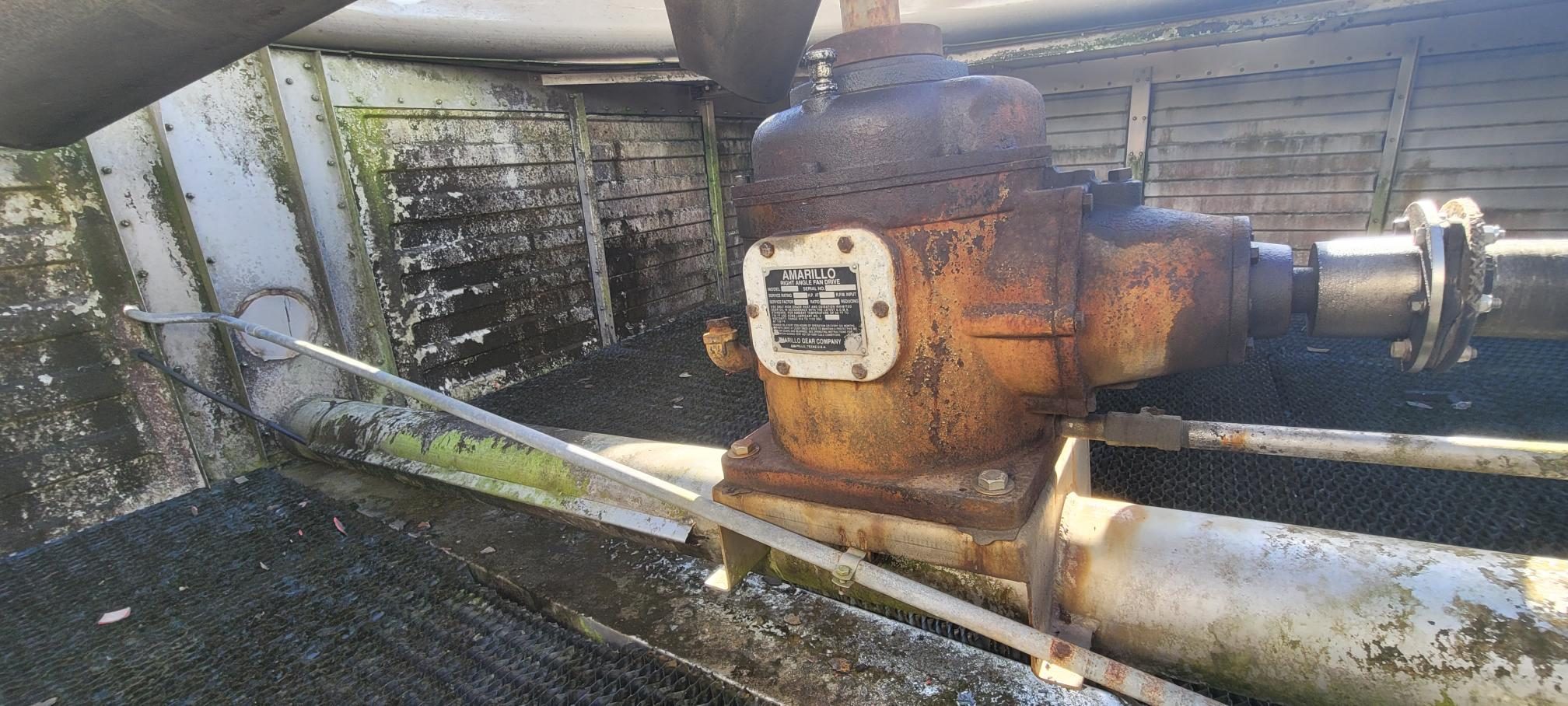
Corrosion through a gear reducer housing and its support steel. This did not happen in one season.
If you only ever do one thing on a schedule, make it the mechanical equipment: oil, alignment, vibration and coupling condition. It is the least expensive to check and by far the most expensive to lose.
What a tower needs, and roughly how often
A general guide for planning, not a substitute for your manufacturer's manual or for an inspection of your specific tower. Intervals shorten considerably with aggressive water chemistry, dirty air, high duty cycles or freeze exposure.
| Item | Typical interval | What you are looking for |
|---|---|---|
| Gear reducer oil level and condition | Monthly | Level, water contamination, metal particles, discoloration |
| Vibration and noise check | Monthly | Any change from the established normal for that cell |
| Gear reducer oil change | Per manufacturer, commonly 6–12 months | Sooner if the oil shows water or wear metals |
| Drive shaft and coupling inspection | Quarterly to semi-annually | Disc pack cracking, fretting, bolt torque, alignment |
| Fan blade and hub inspection | Semi-annually | Erosion, leading-edge damage, blade pitch, tip clearance, hardware |
| Vibration switch function test | Semi-annually | That it actually trips; an untested switch is not protection |
| Fill and drift eliminator condition | Annually | Fouling, scale, collapse, sagging, displaced or missing sections |
| Water distribution | Annually | Plugged or missing nozzles, dry patches, uneven basin loading |
| Structural inspection | Annually | Connection hardware, member condition, fan deck, casing, basin |
| Safe-access inspection | Annually | Ladders, stairs, walkways, grating, handrails and kneerails |
| Basin clean-out | Annually, or as water treatment dictates | Silt, debris, biological growth, screen condition |
| Thermal performance test | Every 3–5 years, or after any upgrade | Capability against design: see ATC-105 testing |
| Pre-freeze readiness check | Annually, before winter | Fan reversal, basin heaters, distribution and bypass arrangements |
| Pre-storm readiness check | Annually, before hurricane season | Casing fixings, fan stack security, loose grating and hardware |
What we can take off your hands
We can carry out any of the above on a schedule that fits your outage planning, or attend once a year to do the parts your own crews cannot safely reach.
Mechanical maintenance
Oil changes, alignment, vibration assessment, coupling and drive shaft inspection, bearing and seal work. Gearboxes can often be rebuilt in place rather than removed.
Internals & distribution
Fill and drift eliminator inspection and replacement, nozzle cleaning and replacement, distribution basin and lateral clean-out, flow control valve service.
Inspection & reporting
A written report each visit covering condition, what was done, what needs attention and what it will cost, so the tower has a documented history instead of an oral one.
Rather than sell you a maintenance package before anyone has seen the tower, we would rather inspect it once and tell you what it actually needs and how often. Some towers need considerably less attention than a generic schedule implies. Some need a great deal more.
Set up a schedule that fits your outage planning
Tell us how many towers you have, what they serve and what your own crews already cover. We will propose the intervals that make sense and stay out of the rest.
- Phone
- (713) 643-0691
- Shop & office
-
3811 Cedar Blvd Ste A
Baytown, TX 77523