
Towers we service
All makes, all models, all types, including a great many towers whose original manufacturers have been sold, renamed or shut down entirely. If it is a cooling tower, we service it.
We do not build towers, so we have no brand to defend
Since 1964 we have repaired, upgraded, inspected and rebuilt towers from every manufacturer. We are not a distributor for any of them.
That independence has a practical consequence. When you ask a tower manufacturer whether your tower should be repaired or replaced, they have an answer they would prefer. We do not, and a large part of our work is telling owners that the tower they were told to replace can be upgraded instead.
It also means an orphaned tower is a normal job rather than a dead end. When the original maker no longer exists, someone still has to identify the fill profile, match the nozzle thread, cross-reference the gearbox and confirm the fan hub bore. That is the work.
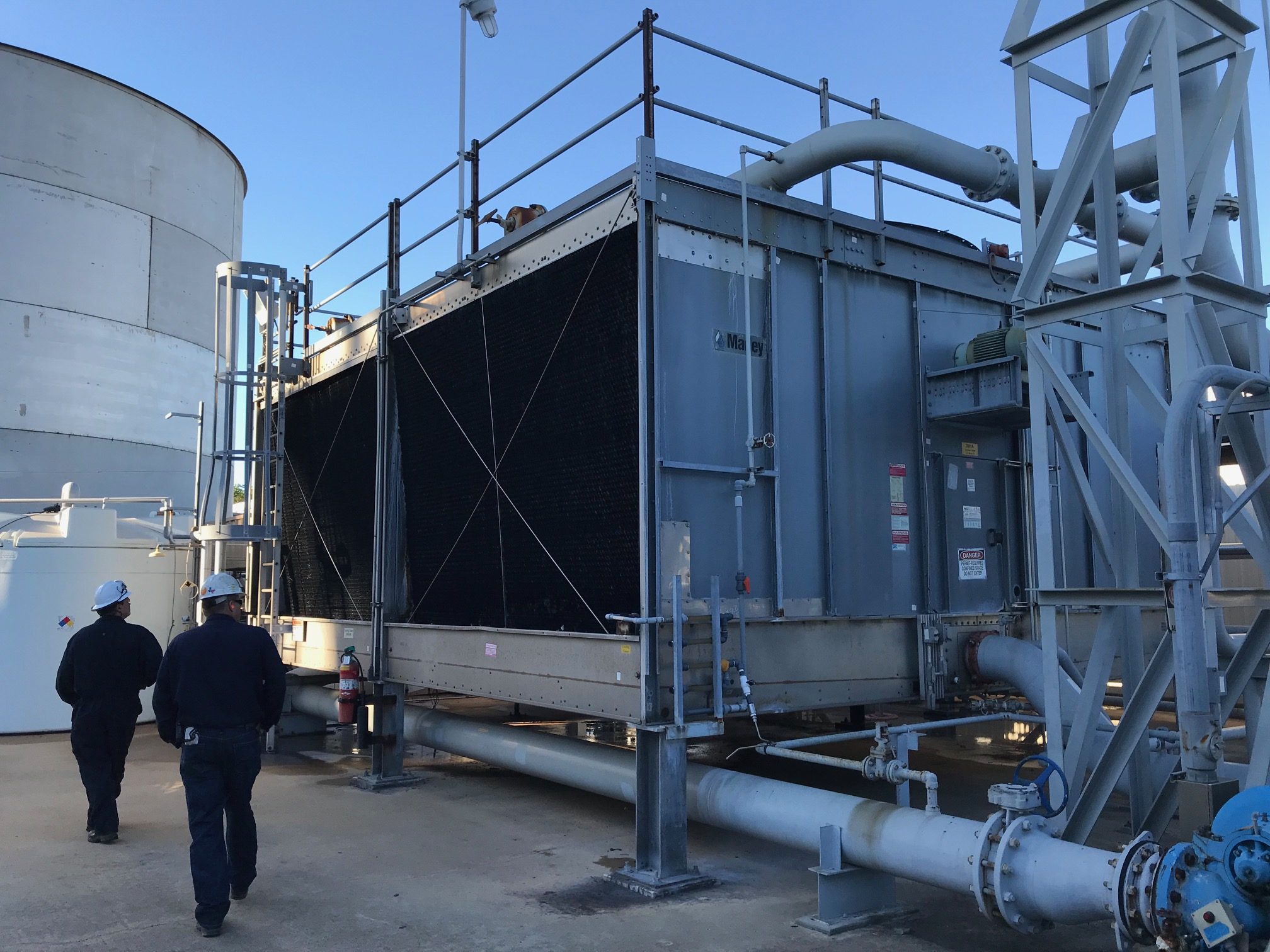
A factory-assembled Marley tower. We service all makes and models.
Makes and model families
If you are searching for a model name you found on a nameplate or a drawing, it is probably in this table. If it is not, it does not mean we cannot help; it means the list is not exhaustive.
Current manufacturers
Still trading, still supporting their own towers. We are not a distributor for any of them, which is the point: the recommendation is not tied to one catalog.
| Manufacturer | Models & families | What we do with them |
|---|---|---|
| Marley · SPX Cooling Technologies | Class 400 · Class 500 · Class 600 · Series 10 · Series 15 · MX75 · M106 · NC Series · MD Series · NC Everest · Aquatower · Quadraflow · Sigma · Alpha Bar · Geareducer | The most common industrial tower line on the Gulf Coast, and the one we are asked about most. We supply Geareducer replacements, and the Amarillo "A" Series is designed as a direct replacement for the Marley right-angle drive line with corresponding mounting dimensions. |
| EVAPCO · EvapTech | Field-erected crossflow and counterflow (EvapTech) · AT · AT Atlas · AXS | One nameplate covers both a rooftop package unit and a multi-cell industrial tower, because EvapTech is the field-erected side of the same business. Counterflow predominates, so the distribution system is an enclosed header and lateral arrangement rather than an open basin you can inspect by eye. |
| BAC · Baltimore Aircoil | Series 3000 · Series V · factory-assembled and field-erected towers · Pritchard | We supply fan stacks, valves and mechanical components for BAC and Pritchard towers, including a 20" cast iron valve that drops straight into a Marley 20" valve position. |
| Hamon · John Cockerill Hamon | Field-erected counterflow and crossflow · concrete and timber structures · mechanical draft, natural draft and hybrid | Large field-erected towers, frequently concrete, up to utility-scale natural draft and hybrid designs. Usually encountered for internals, distribution, mechanical equipment and basin work rather than structural replacement. |
| Composite Cooling Solutions · CCS | Custom field-erected FRP and concrete · crossflow and counterflow · FM Approved structures | Formed in 2004 by the engineers who had been designing Ceramic Cooling Tower towers until that company closed in 2003, which is why the two names turn up together: a CCT tower on site, and CCS as the line of descent for its distribution and fill. |
| STAR Cooling Towers | Field-erected crossflow and counterflow · FRP and timber | A Texas and Gulf Coast regional builder, so their towers appear on refining and chemical sites inside our own service area more often than their national share would suggest. |
| Cooling Tower Depot | Field-erected crossflow and counterflow · FRP, timber and custom systems | Field-erected towers from roughly 3,000 to 300,000 gpm, so the same make spans a single-cell process tower and a large multi-cell installation. Confirm which before cross-referencing a component. |
| International Cooling Tower · ICT | Field-erected crossflow and counterflow · FRP, timber and concrete | A North American contractor-manufacturer with a strong Gulf Coast presence, so their towers are common on refining and oil and gas sites. |
| American Cooling Tower · ACT | Field-erected and package towers · ACF · ACX · FRP, timber, steel and concrete | A long-established independent that builds heavily customized towers, which makes the model designation a weaker guide than the tower itself. Measure the fill profile and the distribution before ordering anything. |
| Tower Tech | TTX · TTXL modular · forced-draft counterflow | Bottom-mounted fans in a factory-preassembled module, so the mechanical equipment sits at grade in dry air instead of on a fan deck in the leaving air stream. Access is genuinely easier; recirculation and inlet icing are the trade-off. |
| Delta Cooling Towers | TMX · TM · Paragon · Pioneer · engineered HDPE · induced and forced draft | Molded HDPE rather than steel or FRP, so the casing and basin are not the corrosion problem they are on a steel package tower and attention moves to the fill, the drive and the distribution. |
| REYMSA Cooling Towers | RT · HFC · fiberglass package towers · CTI-certified lines | FRP package towers common across North America and Mexico. Fill, drift eliminators, drives and nozzles are all ordinary serviceable items. |
| Babcock & Wilcox · SPIG | Mechanical and natural draft field-erected towers · FRP, concrete and timber | Turnkey supplier on power and oil and gas projects, so these are usually large installations where the work is fill, distribution, eliminators and mechanical equipment. |
| Paharpur Cooling Towers | Field-erected and factory-assembled · FRP, concrete and timber · crossflow and counterflow | One of the largest tower manufacturers globally, so their towers turn up on internationally engineered projects and on plants built to a parent company standard. |
| The Cooling Tower Company · TCTC | Shop-assembled evaporative towers · induced and forced draft | Shop-assembled towers in corrosion-resistant construction, installed across the United States and Canada. |
| Cooling Tower Systems | T-series packaged industrial towers · fiberglass | Smaller packaged duties, shipped complete. Normally a coating, basin and drive conversation rather than a structural one. |
Lines no longer in production
The tower is fine. The support behind it is gone. These are normal jobs for us rather than dead ends, and they are the reason this page exists.
| Manufacturer | Models & families | What we do with them |
|---|---|---|
| Ecodyne | Crossflow and counterflow field-erected towers · MP counterflow nozzles | A line whose original support is long gone. Replacement nozzles, fill, eliminators and mechanical equipment are all still available through us; the Fisher counterflow nozzle replaces the old Ecodyne MP nozzle directly. |
| Lillie-Hoffman | Timber field-erected towers | No longer in business. These towers are entirely serviceable and are exactly the case this page exists for: the tower is fine, the manufacturer is not. |
| Ceramic | Ceramic tile fill · concrete structure | Unusual, extremely long-lived and requiring genuinely specialist knowledge. We have worked on them. |
| Thermal Dynamic · GEA · Psychrometric Systems | Counterflow towers and distribution systems | The Fisher polypropylene counterflow nozzle to CTI Standard 101 replaces the nozzles in all three of these lines. |
Anything else
| Manufacturer | Models & families | What we do with them |
|---|---|---|
| Any other manufacturer | Including towers with no nameplate at all | We do not manufacture towers, so no make is unwelcome. If it is not listed above, that is not an obstacle; send photographs and we will identify what is fitted. |
Extremely common on towers thirty years and older: the plate corrodes away or gets painted over. We identify towers from their construction: fill profile, distribution arrangement, framing details, gearbox casting marks. Photographs are usually enough.
Tower configurations, and what each one means for you
Configuration determines how a tower fails, how it is inspected and what an upgrade can achieve. If you are not certain which you have, this should settle it.
Crossflow
Air moves horizontally through the fill while water falls vertically. Water is delivered to open hot water basins above the fill and flows through gravity nozzles, which makes distribution easy to inspect and clean; you can stand and look at it. The trade-off is that the open basin is exposed to daylight, so algae growth is a persistent maintenance issue, and basin covers are worth considering.
Counterflow
Air moves vertically upward against falling water. Distribution is an enclosed, pressurized header and lateral system with spray nozzles, which keeps daylight off the water and greatly reduces algae, but means you cannot see a developing problem without opening it up. Counterflow generally achieves a closer approach to wet bulb, which is why crossflow-to-counterflow conversion is a real upgrade path.
Doubleflow
A crossflow tower with air entering through fill banks on both sides of a central plenum. Common in large field-erected industrial towers because it packs more fill area into a given plan footprint. Both inlet faces and both distribution basins need attention, which is regularly forgotten when only one side is accessible.
Single flow
A crossflow tower with one fill bank and one air inlet face, with the opposite side closed off. Used where a tower must sit against a building or where prevailing wind or recirculation makes a single orientation preferable.
Induced draft
The fan sits at the top of the tower and pulls air through it, which is the configuration of the overwhelming majority of industrial towers. It puts the mechanical equipment (gear reducer, drive shaft, motor, fan) up on the fan deck in the leaving air stream, which is why access, walkways and grating matter so much on these towers.
Forced draft
The fan sits at the air inlet and pushes air through. It puts the mechanical equipment at ground level in dry air, which makes maintenance much easier and is the main reason it is chosen. It is more prone to recirculation of saturated leaving air back into the inlet, and to icing at the inlet in winter.
Hyperbolic · natural draft
The large concrete chimney towers associated with power stations. Air flow is driven by the density difference between warm humid air inside and cooler ambient air outside, so there are no fans and no mechanical equipment at all. The work is fill, distribution, eliminators and concrete.
Circular
Round mechanical-draft towers with a single central fan and fill arranged around it. Efficient in plan area and used where footprint is constrained. Distribution geometry is unlike a rectangular tower and needs to be understood before parts are ordered.
Factory-assembled · package
Delivered largely complete on a truck, in steel or FRP, typically for smaller duties and HVAC. Service life is dominated by the casing and basin coating system and by the water chemistry. Steel basins rusting through is the classic failure.
Field-erected
Built on site in timber, concrete, steel or fiberglass, generally multi-cell and generally industrial. These are the towers where on-line replacement matters, because a cell can be taken out and rebuilt while the others keep running.
HVAC · comfort cooling
Rooftop and grade-mounted towers serving chillers in hospitals, campuses, offices, arenas and data centers. Same components, different buyer and much tighter constraints on noise, access and occupant disruption. See HVAC cooling towers.
Every structural material, every market
Structural materials
- Timber — Douglas fir & redwood
- Concrete
- Steel
- Fiberglass / FRP
Markets
- Refineries
- Petrochemical
- Chemical
- Power generation
- Cogeneration
- Pulp & paper
- Air separation
- Plastics
- Steel
- Food processing
- Utilities
- HVAC & institutional
Tell us what is on the nameplate
Or tell us there is no nameplate. Either way, send a photograph of the tower and of the component you are concerned about, and we will tell you what it is and what we would do about it.
- Phone
- (713) 643-0691
- Shop & office
-
3811 Cedar Blvd Ste A
Baytown, TX 77523