
Fans
The fan moves the air, and air is what actually does the cooling. A fan that has lost blade profile, pitch or tip clearance quietly costs you both cooling capacity and fan power at the same time.
Understanding the component
A cooling tower fan is a large, slow, low-pressure axial fan (commonly between 4 and 40 feet in diameter) made up of an airfoil-section blade set bolted into a hub. Modern blades are hollow fiberglass or extruded aluminum; older towers may still have solid or wooden blades.
Two things separate an efficient fan from an inefficient one. The first is the blade section: varying chord width and angle of attack along the blade length yields considerably higher performance than a constant-chord blade, which is why replacing a first-generation fan can reduce horsepower for the same duty. The second is tip clearance: the gap between blade tip and fan stack. Air that recirculates through that gap does no cooling at all.
Blades are moment-balanced to a master standard, which means a single damaged blade can normally be replaced individually rather than buying a matched set.
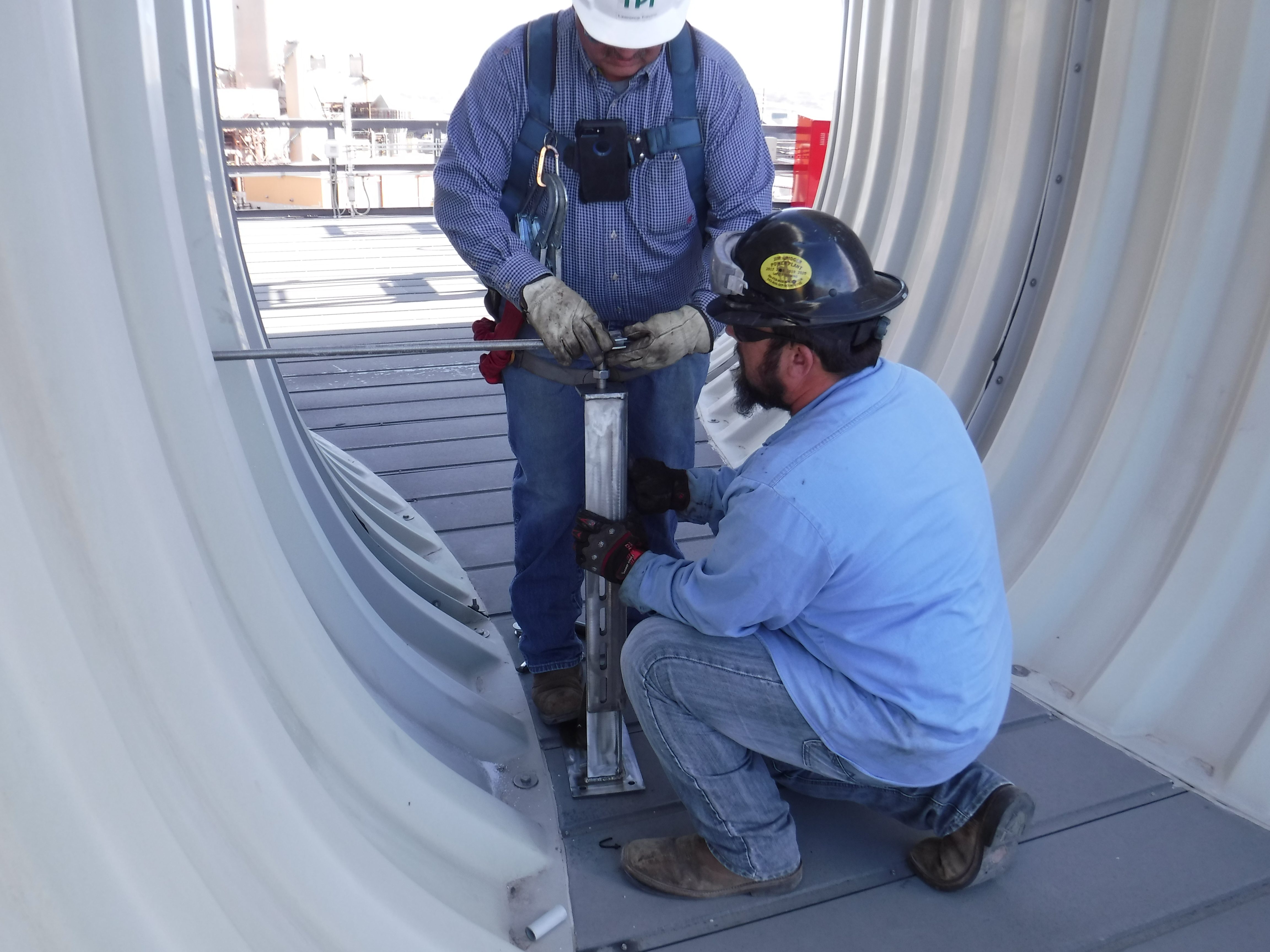
Fan stack support installation.
We supply components for cooling towers from every manufacturer, including towers whose original makers no longer exist. If it is on your tower, we can identify it.
What actually goes wrong
These are the failures we find in the field, roughly in order of how often we find them. If you recognize one, we can usually tell you what to check next over the phone.
| Failure | What it means |
|---|---|
| Leading-edge erosion | Water droplets and grit strip the leading edge over years. The blade loses section, then loses performance, then loses strength. |
| Pitch drift | Blades that have moved out of their set pitch, or were never correctly set, give uneven air distribution and cost power for no benefit. |
| Cracking at the root | Fatigue cracking where the blade enters the clamp or hub. This is the failure that throws a blade, and a thrown blade destroys the stack and frequently the gearbox. |
| Hub and hardware corrosion | Corroded clamps, bushings and fasteners. Fan hardware is the least glamorous and most safety-critical item on this page. |
| Imbalance | Shows up as vibration, which the vibration switch should catch. Caused by a damaged blade, water trapped inside a hollow blade, or deposits on one side. |
Manufacturers and product lines
We are independent, so the recommendation follows your tower, your water and your duty rather than a single manufacturer's catalog.
Hudson
Tuf-Lite and Tuf-Lite II fiberglass blades and hubs. One-piece airfoil construction, moment-balanced blades, and a ceramic Tuf-Edge leading edge on Tuf-Lite II that resists droplet and dirt erosion. Hubs can be manufactured to fit other manufacturers' gear reducers.
Amarillo Chittom
PowerFlo assemblies: twisted and tapered airfoil in lightweight aluminum, available from 4 to 14 feet, with guaranteed performance and noise levels and single replacement blades available.
Moore Fan Company
Class 5000 axial fans in all-aluminum construction, 3 to 24 feet, with individually balanced blades that are freely interchangeable between fans of the same series and diameter, so the exact blade count can be selected for the duty rather than accepting excess blades.
Cofimco
Adjustable-pitch hubs permitting diameters up to about 40 feet, with extruded aluminum or pultruded FRP blades that can be cut to any diameter, and options for very low temperature environments.
Marley and Howden
Replacement blades, hubs and hardware for the original lines.
Names you may find on the nameplate
Including lines that are no longer current. Many of the towers we work on are thirty to fifty years old, and identifying the modern equivalent of a discontinued component is part of the job rather than an obstacle to it.
- Hudson Tuf-Lite
- Hudson Tuf-Lite II
- Amarillo Chittom Airflo
- Moore Class 5000
- Cofimco
- Marley
- Howden
What we would tell you on the phone
Low-noise options exist.
For HVAC, campus and any tower near a property boundary, lower-speed blade designs achieve the same duty at reduced noise. If noise is a constraint, say so at inquiry stage; it changes the selection.
Fan and stack are one system.
There is no point fitting a precision fan assembly inside a distorted fan stack. Tip clearance is set by both, so we look at the stack whenever we replace a fan.
Measure before you order.
Diameter, blade count, hub bore and taper, shaft arrangement and existing tip clearance. We would rather survey it than have you take delivery of a fan that does not fit.
Usually replaced or inspected at the same time
Fan stacks
FRP fan cylinders and velocity-recovery stacks in Class I, II and III fire ratings: Midwest, Polymer Fabrication and BAC · Baltimore Aircoil.
View componentGear reducers
Right-angle fan drives, including direct replacements for the Marley Geareducer line. Frequently rebuilt in place.
View componentDrive shafts & couplings
Composite and steel drive shafts with flexible disc couplings: Addax, Amarillo, Rexnord Thomas and TB Wood's.
View componentVibration switches
Mechanical and electronic vibration cut-outs: Murphy VS2, PMC/BETA and Metrix. The cheapest protection a fan drive can have.
View componentSend us the nameplate and we will identify it
The fastest route to a correct quote is a photograph of the nameplate and of the component in place. Model numbers get superseded and drawings go missing; photographs do not lie.
- Phone
- (713) 643-0691
- Shop & office
-
3811 Cedar Blvd Ste A
Baytown, TX 77523