
Lumber & hardware
Timber towers are repairable member by member, which is a real advantage over steel, provided the replacement timber is the right grade and the hardware suits the water.
Understanding the component
A great many industrial cooling towers are timber-framed, and they last remarkably well when built and maintained properly. The timber is pressure treated, and the structural grades used in cooling towers are defined by the Cooling Technology Institute; CTI grades are available in all sizes in both Douglas fir and redwood.
We have sources for lumber, fabricated and unfabricated, across the United States, and timber can be supplied custom fabricated to your drawings or plain for field fabrication. Plain-face and tongue-and-groove treated plywood is also available for decking and partition work.
Hardware is the part people get wrong. A timber tower is held together by its bolts, and the alloy has to suit the water chemistry, not the budget. We supply fasteners in 304 and 316 stainless steel, silicon bronze, monel and hot-dip galvanized. On aggressive water, monel and 316 earn their cost several times over; on benign water, galvanized is entirely adequate.
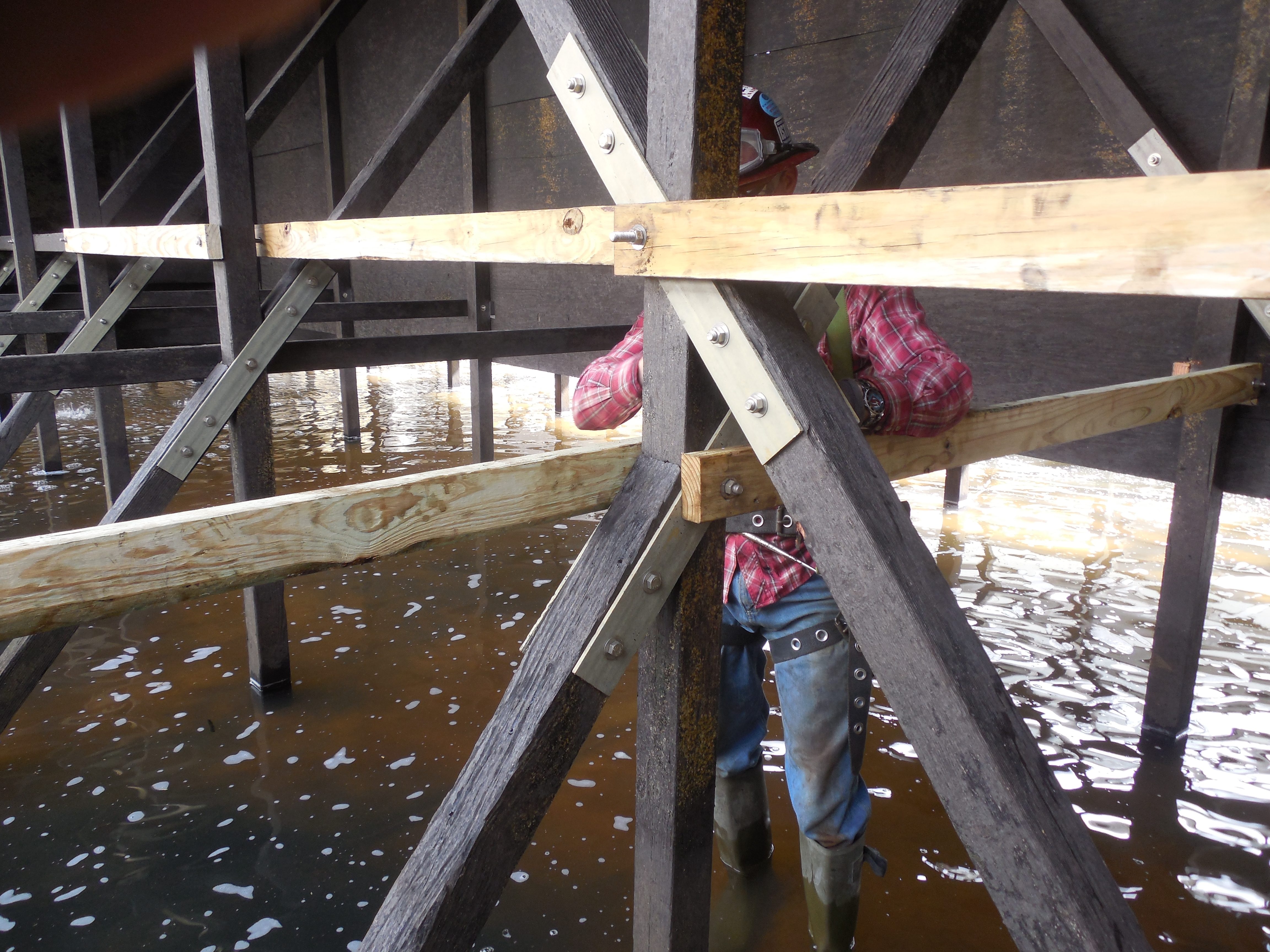
Structural timber replacement worked in-basin, cell by cell.
We supply components for cooling towers from every manufacturer, including towers whose original makers no longer exist. If it is on your tower, we can identify it.
What actually goes wrong
These are the failures we find in the field, roughly in order of how often we find them. If you recognize one, we can usually tell you what to check next over the phone.
| Failure | What it means |
|---|---|
| Rot at connections | Where water sits against a joint. Timber towers almost always fail at connections rather than mid-member. |
| Corroded hardware | The single most common structural finding. Bolts wasted to a fraction of their original section while the timber around them looks acceptable. |
| Galvanic corrosion | Mixed metals in wet, conductive water. Mixing alloys in a connection because that is what was on the truck causes this. |
| Splitting and checking | Around fasteners, particularly where members have been through repeated wet and dry cycles. |
| Soft rot in the fill area | Constant wetting plus warmth. The fill supports and the timber immediately around them are always worth probing. |
| Delaminated plywood | Decking and partition plywood failing at the glue lines. |
Manufacturers and product lines
We are independent, so the recommendation follows your tower, your water and your duty rather than a single manufacturer's catalog.
CTI-grade Douglas fir
Pressure treated, in all sizes, fabricated or plain.
CTI-grade redwood
Pressure treated, in all sizes, fabricated or plain.
Treated plywood
Plain face and tongue-and-groove.
Stainless fasteners
304 and 316: bolts, nuts, washers, connector plates and specialist cooling tower hardware.
Monel and silicon bronze
For aggressive water chemistry where stainless is not sufficient.
Hot-dip galvanized
Where the water chemistry and design life justify it.
Grades, species and alloys we supply
Timber and hardware are specified by grade, species and alloy rather than by make. Matching the original species and grade matters: substituting one for another changes both the strength and the service life of the member you are replacing.
- CTI grade
- Douglas fir
- redwood
- treated plywood
- 304 stainless
- 316 stainless
- monel
- silicon bronze
- hot-dip galvanized
What we would tell you on the phone
Tell us the water chemistry, not just the bolt size.
pH, chlorides, treatment program and whether the tower has had a corrosion problem before. Hardware alloy is a chemistry decision and getting it wrong is expensive twice: once for the hardware and once for the structure it fails to hold together.
Do not mix alloys in a connection.
Galvanic corrosion in a wet, conductive environment will attack the less noble metal quickly. Consistency within a connection matters more than the specific choice.
Fabricated timber saves field time.
Pre-cut and pre-drilled members reduce work at height and inside the tower, which is both quicker and safer. Worth it on anything other than a handful of members.
FRP is an alternative.
Where timber has failed repeatedly because of water chemistry, FRP structural shapes may be the better long-term answer.
Usually replaced or inspected at the same time
FRP shapes
Pultruded fiberglass angle, channel, tube, decking, grating and walkway sections for structural and safe-access work.
View componentCasing & louvers
FRP casing in 4.2 corrugated and 5.33 V-Beam profiles, and inlet louvers. Fire rated panels available with UL flame spread of 25 or less.
View componentDistribution systems
Counterflow header and lateral systems and crossflow distribution basins, including redesign to correct uneven water loading.
View componentFill
Film and splash fill for counterflow and crossflow towers, including fouling-resistant grades: Brentwood and C.E. Shepherd.
View componentSend us the nameplate and we will identify it
The fastest route to a correct quote is a photograph of the nameplate and of the component in place. Model numbers get superseded and drawings go missing; photographs do not lie.
- Phone
- (713) 643-0691
- Shop & office
-
3811 Cedar Blvd Ste A
Baytown, TX 77523